Sunday, July 3, 2016

Postcard: People and Places

My final "postcard" blog about my recent river cruise is just that--a collection of pictures of some of the people we met, silly fun we had, and things we saw on our 15-day journey from the Netherlands to Austria.


Large, ornate, seagoing vessels? Thumbs-up.


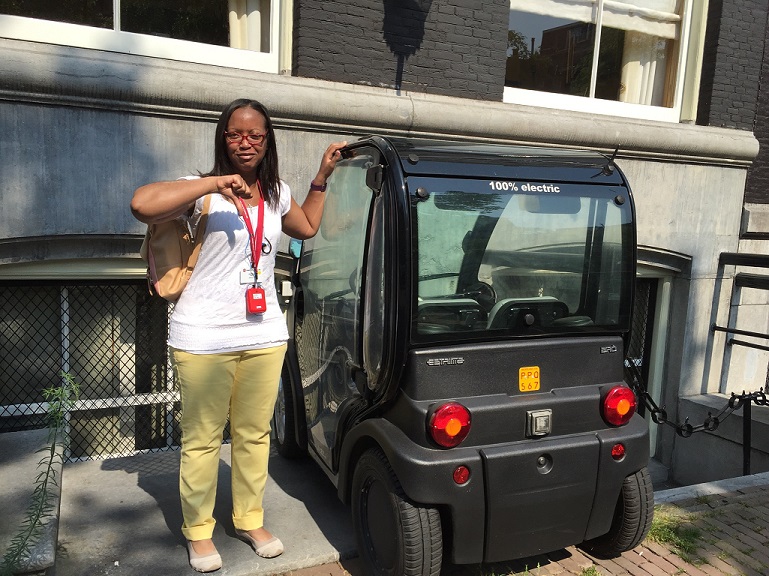
Teeny tiny cars that can park
on a sidewalk? Angela gives 
that a thumbs-down.


Safety drill!
photo courtesy of Angela Pratt

Our Program Director, Udo, shows us how to
eat raw fish the Dutch way--
with plenty of onions and pickles.

The birthplace of cologne
You know it's been a rough night in Amsterdam 
when the streetlights need a break!
Kaiser Wilhelm statue in Koblenz
View of Heidelberg from the castle
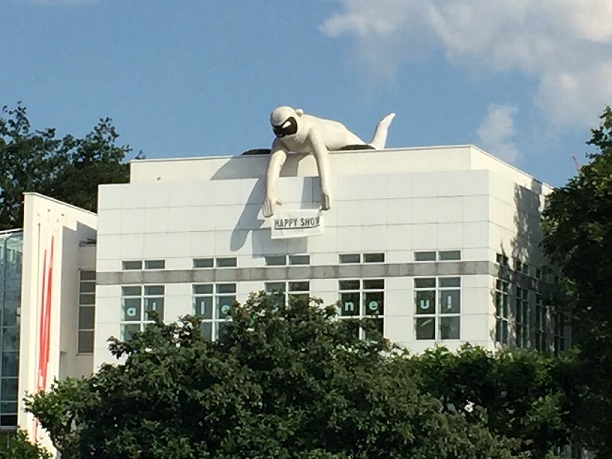
Saw this...whatever it is...on a building
as we sailed out of Frankfurt


Rain was keeping river levels high, making our passage
under some bridges rather tricky. A couple of times we were
near the point of having to leave the ship and
continue our journey via bus.
Although I wasn't awake for all 66 locks we sailed
through, I watched our passage through
as many as possible. As you can see,
not a lot of wiggle room, and our crew
steered through them manually,
with no GPS or radar aids.
Wertheim is known for glassblowing, so we got a private demo
by a local artist before we set out for the day.


The old main bridge in Würzburg

Good clean fun in Rothenburg
A pig in--where else--Schweinfurt!
Früschoppen - a brunch tradition that, in some parts of Germany,
may involve more beer than food


Another German tradition is that of journeyman workers. While walking toward old town Bamberg we ran into this roofing journeyman, who will travel for the next couple of years with just the belongings under his arm, finding work, food, and shelter by the grace of the people in the towns through which he travels.

I thought maybe it was something that was only alive and well in the southern areas of Germany, but when I got back, I noticed a couple of journeymen in their traditional garb walking through downtown Hamburg.
One side of an incredibly creepy statue 
in Nuremberg


and...the other side


An example of the lovelier side of Nuremberg's history
Yes, this is a highway overpass, which means that the cars you see are driving under us as we sail across!
Ferry ride through the Danube Gorge
...and by the afternoon he's picked up
a new hat in Regensburg!

All in a day's work!
After a morning visit to the Weltenburg
Abbey, Larry has secured a baby keg
of the monks' very good beer...


Looking down over the city of Passau. There's our ship, Grand Circle Cruise Line's MS River Harmony!
The Loreley rock
Ruins of the castle in Düernstein where Richard the Lionheart was held captive in 1192.

We saw numerous examples of Fachwerkhaus construction in some not-so-common colors. 
Although this looks like some kind of fake photo backdrop,
the abbey on the hill is real. I'm guessing the wheel 
is a semi-permanent way to promote the show 
on the poster behind me. 

A few members of our incredible crew
photo courtesy of Angela Pratt

This swimming pool is the only part of
Danube we saw that was actually blue.
The Wachau Nose


at the Spanish Riding School in Vienna
photo courtesy of Angela Pratt


This is a video clip of a troupe that came aboard and 
performed some traditional Bavarian dances for us.


photo courtesy of Angela Pratt


Did you miss any of my previous "postcards" from this trip? You can find them here:

Time Travel
Medieval Madness
The Royal Treatment
Abbeys & Cathedrals
Darker Days

Saturday, July 2, 2016

Postcard: Darker Days

Several common themes appeared throughout our river cruise. The one that should not have surprised me did just that, as I realized how far-reaching and deep ran its network of scars.

Amsterdam, the Netherlands

Statue of Anne Frank
near the church she
mentions in her diary.
Our first afternoon in town we went to the Anne Frank House. It's an informative, thought-provoking experience, especially as you wind your way up and through to the secret annex in the back, where the Frank family and others hid for two years.

One of the last exhibits explains where the inhabitants of the house were taken. Anne's roommate, Fritz Pfeffer (known as Albert Dussel in her diary), was taken to Neuengamme in October 1944 and died there two months later.

Although I haven't read The Diary of Anne Frank in decades, I remembered my sense of it. And I entered the house expecting to be impacted most by the plight of this young girl and her family.

Instead, I stood staring at Fritz Pfeffer's picture and final bio, stunned to find myself visiting here, where he hid with some hope for the future, when only last month I visited Neuengamme, where he labored and suffered and died at the age of 55.


Nuremberg, Germany

It's a shame that the vibrancy of Nuremberg is shadowed by its past, but the truth is the Nazi Party had big plans to make it their center of power, and it feels like the city is being careful to balance the responsibility of educating people about that legacy.

The Nazi Party rally grounds in Nuremberg
We visited the buildings that remain from the Nazi era, the courtroom where the first trial for "major war criminals of the European Axis" took place, and the Dokumentationszentrum--a comprehensive history of the rise of National Socialism. 


Courtroom 600, site of the first and most famous of the Nuremberg trials
Near the end of the Dokumentationszentrum journey, I hit a wall. They were showing footage from concentration camps: naked human bodies stacked like firewood or carelessly tossed into large piles. 

I began to cry. 

In almost every town we'd visited, there was mention of a former Jewish quarter, a marker for a former synagogue, and streets named or formerly named for a Jewish neighborhood. In one city, our guide told us the Jewish population was around 1,500--roughly a tenth of what it had been prior to the war. 

Vienna, Austria
Memorial to victims of National Socialism.
Nearby is a plaque dedicated to Nazi Party deserters.
As I walked out of the main exhibit area, I looked inside the unfinished Congress Hall, adjacent to the document center.

Trees grow in what would have been the building's vast interior. Down the road, another former Nazi building--in a sweet bit of irony--houses the office of immigration.

Instead of tearing them down and pretending they didn't exist, I think it's good that we keep these places. They serve the purpose of all scars--to remind us of our pain and teach us to be more mindful/careful/open/human in the future.


Friday, July 1, 2016

Postcard: Abbeys & Cathedrals

If you want to be awed, visit a cathedral. An old one. Full of marble and gold leaf and swirling fresco, created by artisans as devoted to their craft as they were to their faith.

If you want to be overwhelmed, visit a bunch of them. ;)

These are just a few of the 15 or so churches I visited on our recent river cruise.


Cologne, Germany

Fun Facts: The Cologne Dom (cathedral) is the second-tallest church in Germany and third-tallest in the world, at 157.4 m (516 ft.). Construction began in 1284, stopped in 1473, began again in 1842, and was completed in 1880.
Cologne Cathedral as seen from the river

Interior of the Cologne Cathedral

View from the cathedral out over the city of Cologne.
Angela and I climbed the 533 steps to the viewing platform of the south tower in about 12 minutes. Whew!


Melk Abbey, Austria

Fun Facts: The Melk Abbey is a Benedictine monastery that has been active since 1089. In addition to the monks, the abbey hosts a school, a museum, and an impressive library that includes a book from the 9th century.

An item on display in the abbey's
museum was this service coffin. Moving
the lever on the side dropped the bottom
open, so the body was released into the
grave and the coffin could be re-used.
Side view of the Melk Abbey

Interior view of the Melk Abbey chapel


Passau, Germany

Fun Facts: The Passau Cathedral (St. Stephen) contains the second largest church organ in the world, with 17,974 pipes.

Interior view of St. Stephen Cathedral
Front view of St. Stephen Cathedral


The main section of the Passau organ. We were able to attend an organ concert, which was truly sublime.

Weltenburg Abbey, Germany

Fun Facts: The Weltenburg Abbey was originally founded around 620. Since the first half of the 8th century, it has operated as a Benedictine monastery. The abbey is also home to the world's oldest monastic brewery--active since 1050!


External view of the Weltenburg abbey chapel.
Looks pretty unassuming, right?


The chapel's high altar features a larger-than-life statue of St. George with the dragon and the princess.
View up to the chapel ceiling. The three tiers of the chapel, from the ground up, represent
different states of being. The darkest is life here on earth, the middle tier is enlightenment,
and the brightest, most colorful tier at the ceiling represents heaven.
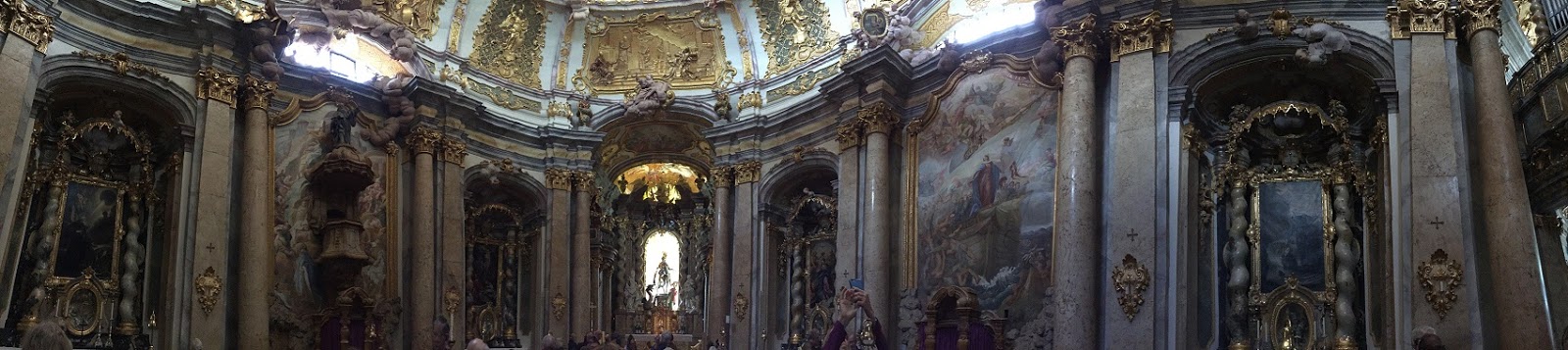
Panoramic view of the chapel interior gives you a small taste of how ornate it is.

Feelings: Toward the end of our cruise I had a conversation with one of my fellow travelers about the abbeys, chapels, and cathedrals we had seen. In summary, I was torn between admiring their displays of opulence and despairing the social opportunity that wealth represented.

Then our conversation led to a broader discussion about legacy and purpose. I thought about my writing and my desire to effect change through my words. It's that passion that inspires you to (hopefully) create something greater than yourself.

I'm not a particularly religious person, but with that thinking, I held a different appreciation for the churches we visited. Besides, there’s no denying the inherent beauty of what those artists brought to life.